Smaller model experiment
nanoGPT · 2025-12-01 · 2 hours
Goal: Train a smaller model with same dataset to see if overfitting is reduced
What I did:
- Trained a smaller (5M param) model on the 200M word wikipedia dataset
- Learned a bit more about LLM scaling laws
- Continued reading transformer literature (ViT, CLiP, etc), working up to VLA work
What worked:
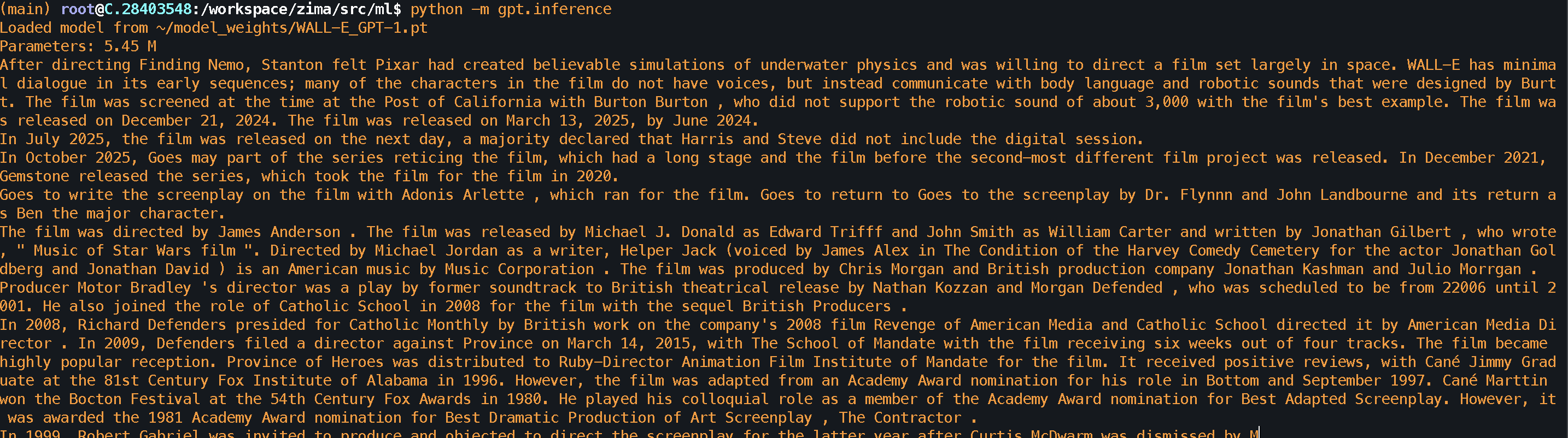
- Model achieved nearly identical performance despite having 6x less parameters and training for less time
- Model was able to capture syntax quite well, and some semantic meaning of words (Movies, Directors, dates, countries, etc.)
- 
What failed:
- Output still fairly incoherent. No long range relationships or intelligent output. Only basic english patterns present in output (correct spelling, nouns and verbs used correctly, very few made up words)
- Even as loss went down after epoch 3-5, model coherence seemed to decrease
- most likely overfitting on my small dataset
Key learning:
- Model of this scale (10^6 params) seems to only be capable of learning syntax and basic semantics
- even the absolute smallest, most compact models (eg. Google Gemma 3 270M-27B) are in the order of 10^8 - 10^10 params
- More epochs and excess model capacity can lead to overfitting quite quickly
- More recent LLM's are increasing token : param ratio, with Gemma 3 270B using 22,000 : 1 ratio
- what does this mean for my robotics projects? How does this scaling compare in vision tasks? Robotics tasks?
- Training ViT and LLM heads from scratch for VLA will be a waste of time, need to fine tune instead or just use as fixed feature extractors
- Zima real world task performance could be very strongly affected by lack of real world data (only 40 trajectories)
-
Next session:
- No more GPT training, move back into robotics work
- Continue reading VLA literature
Time spent: 2 hours